Alipay & WeChat Pay for Foreigners
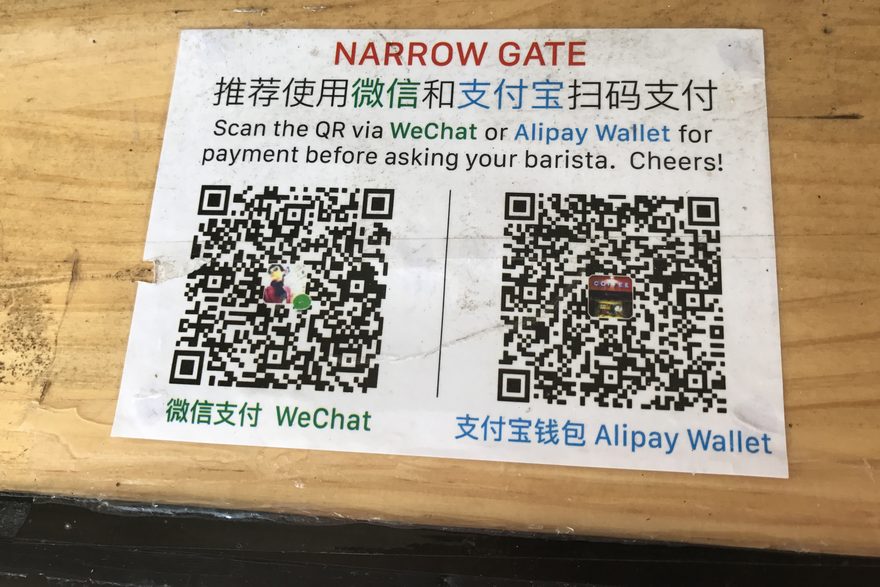
China runs on QR codes. Card terminals exist at large hotels and airports and are close to useless everywhere else — at a noodle stall, a taxi, a convenience store or a market, you scan. That makes setting up a wallet before you fly the single highest-value half-hour of trip preparation you can do.
You do not need a Chinese bank account, and — contrary to what a lot of guides still say — you do not need a Chinese phone number either. Weixin Pay's own help centre is explicit: you can use your international phone number as long as it can receive SMS verification codes.
The short version
- Two apps, not one. Their merchant networks overlap but are not identical, and some shops take only one. Install both before you fly.
- Passport verification first. Real-name verification with your passport is what unlocks the spending limits. Do it days ahead, not at the airport.
- ¥200 is the dividing line. Single transactions at or below ¥200 carry no platform fee; above ¥200, both apps charge 3%.
- The 3% is not the expensive part. Your own bank's foreign-transaction and currency-conversion charge, typically 1–3%, is usually the bigger leak — and it is the one you control.
- Foreign cards cannot send red packets or transfer money to people. They work for purchases at merchants, and not for peer-to-peer transfers.
- Carry ¥300–500 in small notes anyway. For the phone that dies, the stall that only takes cash, and the temple donation box.
Can you avoid the 3%?
This is the question people actually arrive with, so here is the honest answer: the platform fee is a rule, not a puzzle. Both Alipay and Weixin Pay charge 3% on a single transaction above ¥200, and there is no setting that turns it off. Schemes to split one purchase into several smaller ones depend on the merchant agreeing, and most will not — do not build a plan around it.
What the rule does mean in practice:
- Everyday spending is already free. Metro rides, taxis, convenience stores, street food and most restaurant meals for one or two people land under ¥200 per transaction, so the fee rarely touches you on a normal day.
- Big-ticket items will carry it. Hotels, train tickets booked inside the app, and any serious shopping are above ¥200 by nature. Treat the 3% as the cost of the convenience and move on.
- Refunds return the fee pro rata. Weixin Pay states that if you request a refund, the transaction fee is reimbursed in proportion to the refunded amount.
The money worth chasing is on your side of the transaction. On top of the platform fee, your issuing bank usually adds a foreign-transaction or currency-conversion charge of roughly 1–3%, and the exchange rate applied is the one set by your card network and your bank — not a rate either wallet controls. On a ten-day trip, switching to a card with no foreign-transaction fee saves more than any amount of transaction-splitting, and it saves it on every payment including the small ones.
Setting up, in the order that works
- Install both apps at home, on your own Wi-Fi. Inside mainland China the app stores do not behave the way they do where you live, and you do not want to be solving that in an arrivals hall. The same applies to your data setup — see staying online in China.
- Register with your home mobile number. Not a Chinese one. The SMS code arrives in under a minute on most carriers.
- Complete real-name verification with your passport. In Alipay this sits under identity verification in settings; in WeChat under Wallet. You upload the passport photo and usually a live selfie. It is normally automatic and quick — but the worst case is a day or two if a document photo is rejected, so do it days ahead rather than on arrival day.
- Add the card. Visa, Mastercard, American Express, JCB, Discover, Diners Club and UnionPay are the networks generally accepted. Bind cards from two different networks if you can; when one is declined, the other often is not.
- Test it on something trivial. Buy a bottle of water. A successful ¥5 payment tells you the whole chain works, at a point where failure costs you nothing.
Use the exact name on your passport across both apps. Mismatches between the registered name and the cardholder name are a routine cause of a binding that silently fails later.
Limits
Weixin Pay publishes its international-card limits directly:
| Limit | Weixin Pay (published) |
|---|---|
| Single transaction | ¥6,500 |
| Monthly cumulative | ¥50,000 |
| Yearly cumulative | ¥65,000 |
For Alipay, the figures you will see quoted vary, because the regulatory ceiling and what a given account is actually granted are not the same thing. At the regulatory level for inbound payments, a passport-verified international cardholder's ceiling is on the order of US$5,000 equivalent per transaction and US$50,000 equivalent per year; what your account is granted in practice depends on how far verification went. Check the limit shown inside your own app rather than trusting a figure in any article, including this one.
One practical consequence: verify your passport early. Until real-name verification clears, your usable ceiling is much lower, and the moment people discover this is a hotel check-in with a deposit.
What a foreign card can and cannot do
International cards are accepted for everyday purchases within mainland China. Weixin Pay's help centre states plainly that they do not support red packets (hongbao) or money transfers — so you can pay a shop, but you cannot send money to a person, split a bill by transferring to a friend, or join in the hongbao at a dinner.
Some services inside the apps also reject foreign cards outright. That is why the fallback stack matters: two wallets, plus cash.
Alipay or WeChat — use both
| Situation | Better choice |
|---|---|
| E-commerce, transport, train bookings | Alipay |
| Small shops, family restaurants, chat-first ride hailing | WeChat Pay |
| Large purchases | Alipay (higher single-transaction ceiling) |
| Everything else | Both bound, plus ¥300–500 cash |
The point of having both is not optimisation — it is redundancy. A rejected QR code on one app usually works on the other, and a dead end at a till is entirely avoidable.
Things that have changed — ignore older guides
- You no longer need a Chinese phone number. This was true for a long time and is no longer. Official help centre: an international number that can receive SMS is enough.
- You no longer need a Chinese bank account. Foreign cards bind directly.
- The prepaid tourist products have been wound down. Alipay's Tour Pass and the equivalents have been discontinued or closed to new applicants. Guides from 2023 and 2024 that walk you through topping up a prepaid tourist card are describing something that no longer exists — bind a card directly instead.
- Limits were raised substantially. Anything quoting a four-figure annual ceiling is out of date.
Checklist
- Install Alipay and WeChat at home; do not wait until you land.
- Register with your home number — no Chinese SIM needed.
- Verify your passport days before you fly, not on arrival day.
- Bind cards from two different networks.
- Use the passport name exactly, on both apps.
- Check the spending limit shown inside your own app.
- Test with a ¥5 purchase.
- Carry ¥300–500 in small notes.
- Check whether your card charges a foreign-transaction fee — and if it does, bring a different one.
If the trip behind all this setup is a sourcing trip — visiting suppliers around Shanghai and the Yangtze Delta — the Business Trips & Factories page describes a small, personally run service for exactly that: airport pick-up, the factory schedule, and someone in the meeting with you. Asking costs nothing.
Sources
- Weixin Pay official help centre — adding and using international cards (documents, phone number, limits, fees)
- Alipay — international card binding and in-app published limits
- People's Bank of China and inbound-payment measures — regulatory ceilings for passport-verified international cardholders